
For many adults, the realization that their childhood was not “normal” happens slowly. It might happen when you visit a friend’s house and notice their parents resolving a disagreement without shouting. It might happen when your spouse asks you a simple question, and you react with intense, disproportionate defensiveness. If you are constantly haunted by pervasive anxiety, perfectionism, or relationship struggles, the root cause is likely family of origin issues.
When you grow up in a chaotic, unpredictable, or emotionally unsafe environment, your developing brain wires itself for survival. You learn to read the mood of a room the second you walk in. You learn to suppress your own needs to keep the peace. Most damagingly, you learn that love is conditional, unpredictable, and often intertwined with pain.
These lingering psychological wounds are known clinically as family of origin issues. While you may have physically moved out of your childhood home decades ago, the unwritten rules and survival mechanisms you learned there are likely still dictating your adult life.
In this comprehensive guide, we will explore the deep impact of dysfunctional family trauma, the survival roles children adopt to cope, and how specialized therapy can help you heal your family of origin issues so you can reclaim your peace.
What Causes Family of Origin Issues?
A dysfunctional family is not necessarily one defined by dramatic, cinematic abuse. In fact, many people who suffer from deep-rooted family of origin issues grew up in middle-class homes with parents who were respected in the community, provided financially, and paid for extracurricular activities. Dysfunctional family trauma is often incredibly covert.
A family system becomes dysfunctional when it fails to provide the emotional safety, consistency, and validation a child needs to develop a secure sense of self. This chaos usually stems from one or more of the following dynamics:
- Substance Abuse: One or both parents struggling with alcohol or drug addiction, making the home environment entirely unpredictable.
- Untreated Mental Illness: Caregivers who suffer from severe depression, narcissistic traits, or borderline personality disorder, forcing the child to manage the parent’s volatile emotions.
- High-Conflict Marriages: A home environment characterized by constant screaming, hostility, or the silent treatment between caregivers.
- Rigid Authoritarianism: Families where perfection is demanded, mistakes are severely punished, and children are not allowed to express independent thoughts or negative emotions.
- Emotional Disconnect: A home that looks perfect on the outside but lacks any warmth, affection, or emotional intimacy on the inside.
Understanding these causes of psychological trauma helps survivors realize that their current struggles are not a result of being “weak” or “broken.” They are a direct result of adapting to an abnormal, highly stressful environment.
The Survival Roles Children Play in Chaos
When a family system is in distress—particularly in homes with addiction or severe mental illness—the children instinctively adopt specific subconscious roles to cope with the chaos. These roles act as psychological armor and are a major component of family of origin issues.
Which of these survival roles did you play?
1. The Family Hero (The Perfectionist)
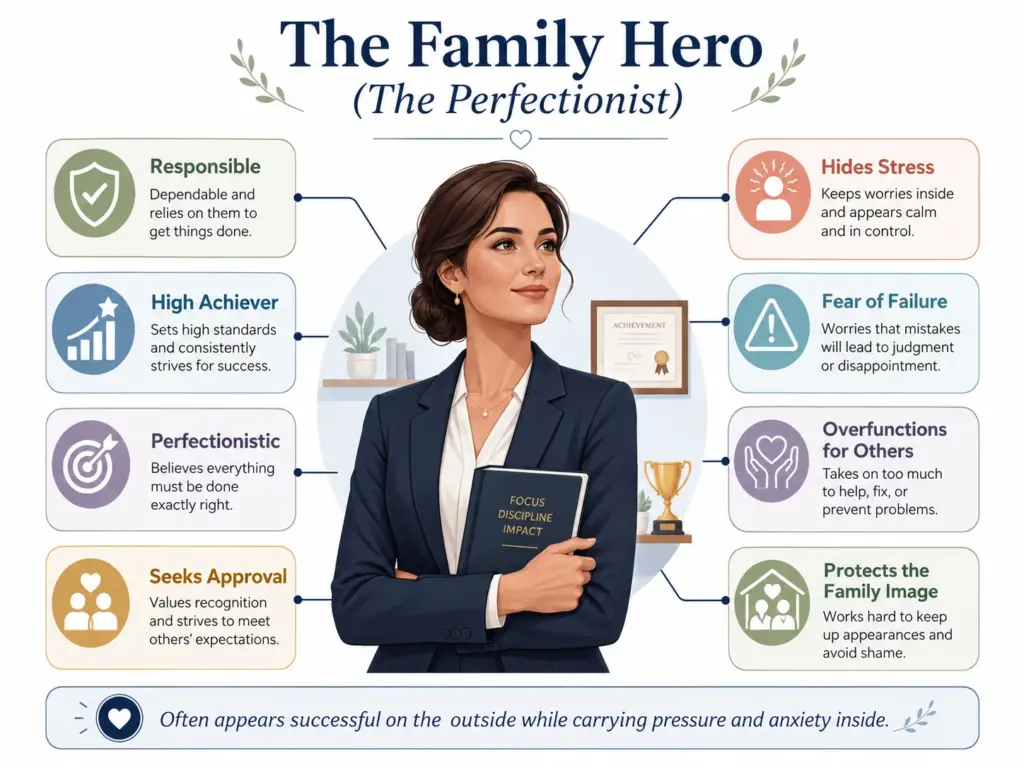
This child attempts to bring esteem and normalcy to the chaotic family through sheer overachievement. They get perfect grades, excel in sports, and never cause trouble.
- The Adult Manifestation: As adults, Family Heroes are often highly successful on paper but suffer from severe anxiety, workaholism, and imposter syndrome. They believe they are only worthy of love if they are performing perfectly, and they struggle deeply with burnout and control issues.
2. The Scapegoat (The Rebel)
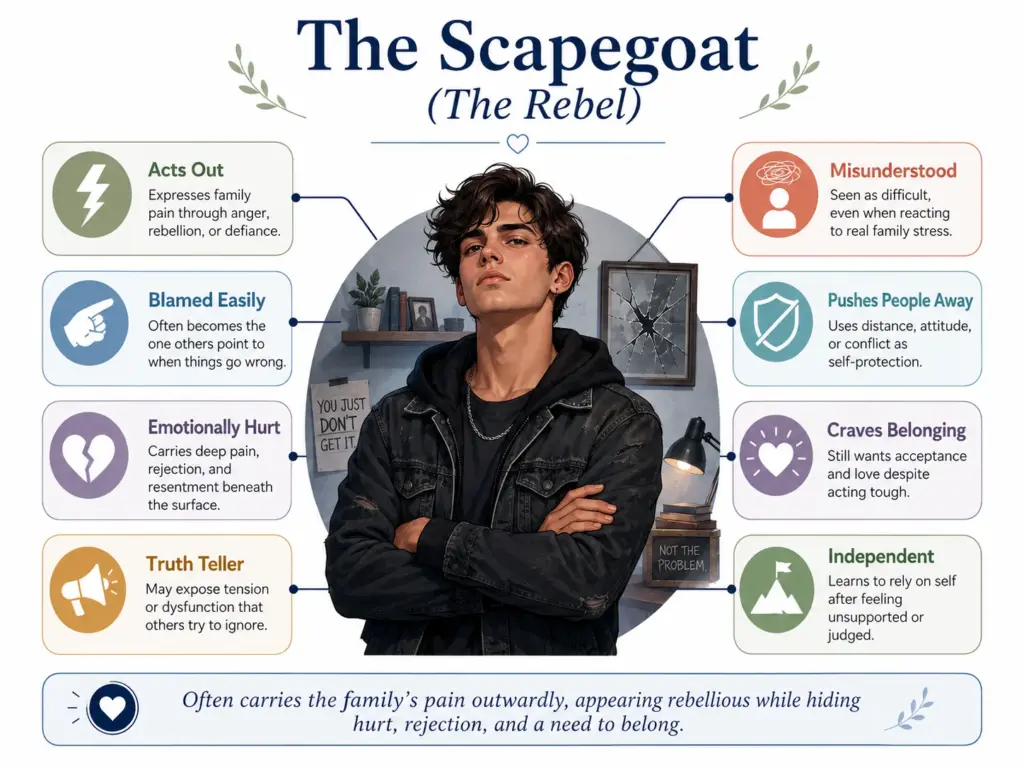
This child diverts attention away from the parents’ dysfunction by becoming the “problem.” They act out, get into trouble at school, or display extreme anger. The family unites by blaming all their unhappiness on the Scapegoat.
- The Adult Manifestation: Adult Scapegoats often struggle with self-destructive behaviors, trust issues, and legal or financial trouble. They may internalize the belief that they are inherently “bad” and frequently find themselves needing therapy for addiction or anger management to process their underlying pain.
3. The Lost Child (The Invisible One)
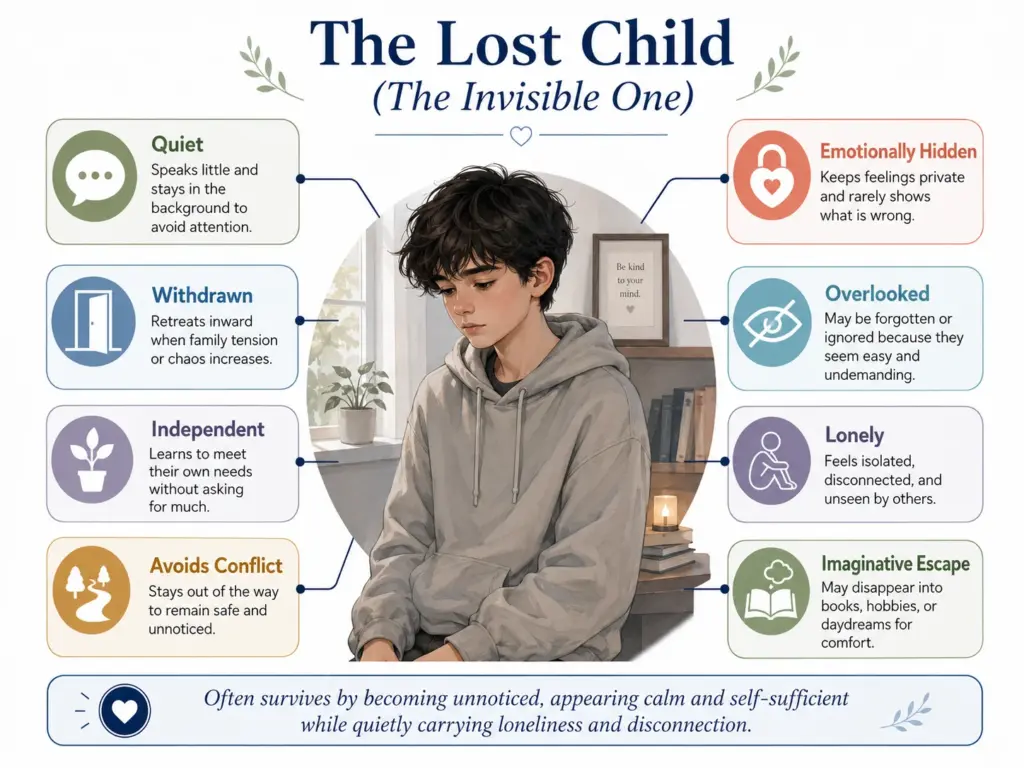
To survive the chaos, this child decides to take up as little space as possible. They are quiet, undemanding, and spend most of their time alone in their room. They fly under the radar to avoid the family conflict entirely.
- The Adult Manifestation: Adult Lost Children are fiercely independent but profoundly lonely. A common marker of their family of origin issues is struggling to form intimate relationships, having a very hard time asking for help, and feeling like they are completely invisible to the rest of the world.
4. The Mascot (The Peacemaker/Joker)
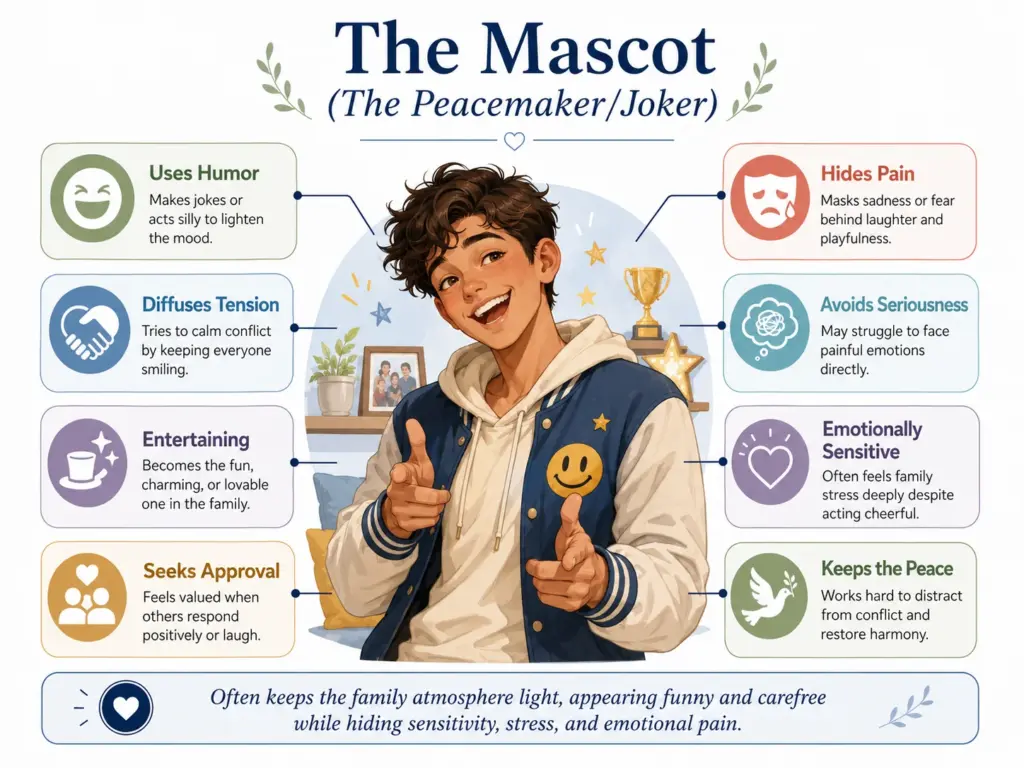
This child uses humor, cuteness, or constant people-pleasing to diffuse the tension in the house. Whenever an argument breaks out, the Mascot steps in to distract and calm everyone down.
- The Adult Manifestation: Adult Mascots use humor as a defense mechanism to avoid dealing with deep emotional pain. They often struggle with severe underlying depression and anxiety, feeling like they must constantly manage the emotions of their spouses, friends, and coworkers.
The Hidden Scars: How Family of Origin Issues Impact Adulthood
You cannot outgrow unresolved trauma. If you do not actively engage in healing childhood trauma, those early survival mechanisms will inevitably sabotage your adult life. Here is how family of origin issues commonly manifest in your day-to-day existence:
1. Chronic Hypervigilance (“Waiting for the Other Shoe to Drop”)
When you grow up in a chaotic home, your nervous system is constantly on high alert, scanning the environment for the next explosion or disappointment. In adulthood, this translates into chronic anxiety. Even when your life is peaceful and your relationship is stable, you cannot relax. Your brain is convinced that disaster is just around the corner.
2. Sabotaging Romantic Relationships
We are subconsciously drawn to what is familiar, even if what is familiar is painful. Adults struggling with family of origin issues frequently find themselves drawn to emotionally unavailable, volatile, or controlling partners. Because they do not know what healthy love looks like, a calm, secure relationship actually feels boring or anxiety-inducing. You can learn more about this dynamic in our guide on how childhood trauma impacts adult relationships.
3. Profound People-Pleasing and Lack of Boundaries
If asserting your needs as a child resulted in you being punished, ignored, or told you were selfish, you learn to silence your own voice. As an adult, setting boundaries feels terrifying. You may constantly overcommit, tolerate poor treatment from others, and feel intense guilt whenever you say “no.”
A Specific Focus: Therapy for Adult Children of Alcoholics (ACOA)
Growing up with a parent who struggles with alcoholism or substance abuse creates a very specific, deeply painful type of trauma. Addiction inherently creates a household of broken promises, gaslighting, and role-reversal (where the child becomes the emotional caretaker of the parent).
Adult children of alcoholics often struggle with a phenomenon called “guessing at what normal is.” Because their reality was constantly denied (“Your father isn’t drunk, he’s just tired”), they grow up unable to trust their own perceptions or intuition. They often take themselves far too seriously, judge themselves without mercy, and have a desperate need to control their environment to prevent the unpredictability they suffered as children.
Specialized therapy for adult children of alcoholics is a critical component of our practice. Healing requires validating the reality of the addiction, grieving the loss of a protective parent, and unlearning the toxic rule of the alcoholic family: “Don’t talk, don’t trust, don’t feel.”
The Silent Trauma: Childhood Emotional Neglect in Edmonton
While explosive chaos leaves obvious scars, the absence of emotional connection leaves an invisible, yet equally devastating, wound.
Childhood emotional neglect occurs when a parent consistently fails to respond adequately to a child’s emotional needs. The parent might not be abusive; they might just be emotionally numb, overworked, or lacking emotional intelligence themselves.
If you grew up emotionally neglected, your trauma is not about what happened to you; it is about what failed to happen for you. You were not taught how to identify, soothe, or express your feelings.
Adults who experienced this form of dysfunctional family trauma often feel a chronic sense of emptiness. They describe feeling like they are watching the world through a pane of glass—disconnected from others and detached from their own joy. Overcoming these specific family of origin issues requires therapy that focuses on building emotional vocabulary, learning self-compassion, and realizing that your feelings actually matter.
Steps to Break the Cycle of Dysfunctional Family Trauma
Breaking generational trauma is perhaps the hardest, most courageous work a human being can do. It means deciding that the toxic patterns passed down through your family tree will stop with you.
While professional therapy is the most effective way to navigate this process, here are the foundational steps to healing your family of origin issues:
1. Break the Denial
The first step is taking your family off the pedestal. Acknowledging that your parents were deeply flawed and that their behavior hurt you does not mean you hate them. It simply means you are committing to living in reality. You must stop making excuses for the adults who failed to protect you.
2. Grieve the Childhood You Didn’t Have
Healing requires profound grief. You must allow yourself to mourn the loss of the safe, unconditional, carefree childhood you deserved but never received. Allowing yourself to feel anger and profound sadness over this loss is a necessary step in releasing the emotional weight you have carried for decades.
3. Establish Firm Boundaries
You cannot heal if you are continually being re-traumatized. Overcoming family of origin issues often requires setting new, firm boundaries with your family members today. This might mean limiting phone calls, refusing to engage in arguments, walking away when boundaries are crossed, or in severe cases, deciding to initiate periods of no-contact for your own mental health.
4. Practice “Reparenting”
Reparenting is the process of giving yourself the emotional support, discipline, and unconditional love that your parents could not give you. When your inner critic is screaming at you for making a mistake, reparenting means consciously stepping in with a compassionate, reassuring internal voice instead.
How Professional Therapy Helps You Heal Family of Origin Issues
Reading about dysfunctional families is one thing; rewiring your nervous system to overcome the trauma is another. This trauma is deeply embedded in the subconscious mind and the body. Overcoming it usually requires the guidance of a trained psychotherapist who can provide a safe, neutral, and validating environment.
At our clinic, we recognize that standard talk therapy is sometimes not enough to heal childhood wounds. Our registered psychologists utilize comprehensive, evidence-based methods to address the root causes of your pain:
- Family of Origin Therapy: We help you map out your family tree, identifying the multi-generational patterns of addiction, neglect, or poor communication so you can consciously choose to behave differently.
- EMDR Therapy: Eye Movement Desensitization and Reprocessing is highly effective for processing both “Big T” and “little t” childhood traumas. EMDR therapy helps move stuck, painful memories out of your brain’s active emotional center, reducing your triggers and chronic anxiety.
- Couples and Marriage Counselling: Because family of origin issues inevitably leak into your romantic life, engaging in Edmonton marriage counselling can help you and your partner stop repeating your parents’ toxic patterns and build a secure, emotionally intelligent partnership.
Find Expert Support for Family of Origin Issues in Edmonton
Growing up in chaos teaches you that you have to survive the world entirely on your own. But you do not have to carry this burden alone anymore. Acknowledging that your past is negatively impacting your present is not a sign of weakness; it is the ultimate sign of self-awareness and strength.
If you are tired of living in survival mode, struggling with perfectionism, people-pleasing, or the lingering shadows of an alcoholic or emotionally neglectful home, we are here for you.
For over 40 years, the dedicated team at Gary J. Meiers, Ph.D., Jo Ann Hammond-Meiers, Ph.D. and Associates Ltd. has helped adults across Edmonton and Strathcona heal from their deepest childhood wounds. Dr. Meiers has extensive experience and required certifications specifically designed to help adults raised in alcoholic families and survivors of dysfunctional homes find their voice and their peace.
We offer a safe, confidential environment where you can unpack your past without judgment. Whether you prefer in-person sessions at our Edmonton clinic or the comfort and privacy of our online therapy services available throughout Alberta, we are ready to help you build a life defined by your choices, not your childhood.
It is time to break the cycle of your family of origin issues. We invite you to visit our home page to learn more about our experienced team, or contact us today at 780-433-2269 to schedule your appointment. Together, we can help you turn your history of chaos into a future of calm.
